There is a certain kind of tournaments that players talk about long after it ends. Not because of the prize money or the venue, but because everything just worked. Check-in was smooth. The draw was out on time. Matches ran on schedule. Communication was clear. Nobody was left standing around wondering what was happening next.
These tournaments do not run well by accident. They run well because the people behind them treat the organisation with the same seriousness as the competition itself.
Most tournaments in India are not there yet. Not because the organizers do not care — they do — but because the systems being used are not built for the job. And at some point, using informal tools for a professional event stops being a workaround and starts being the reason the event cannot grow.
What Makes a Tournament Feel Professional
Players and parents may not always be able to explain what made an event feel well-run, but they know it when they experience it. A few things stand out consistently:
- Registrations are simple and confirmed quickly. Players know they are in without having to follow up.
- The draw is published in advance. Players can plan their day, their travel, and their schedule.
- Communication is clear and timely. Updates reach everyone who needs them, without confusion.
- Match day runs on time. Courts are ready, opponents are present, and delays are the exception rather than the rule.
- Results are recorded properly. There is an official record of the event, not just a WhatsApp message with the final score.
When all of these things are in place, the tournament feels credible. Players take it seriously. Coaches recommend it to their students. Sponsors consider it worth associating with.
The Gap Between Intention and Execution
Most tennis organizers intend to run a professional event. The gap is in execution, and execution depends entirely on the tools and systems being used.
Here is what happens when the systems are not up to the task:
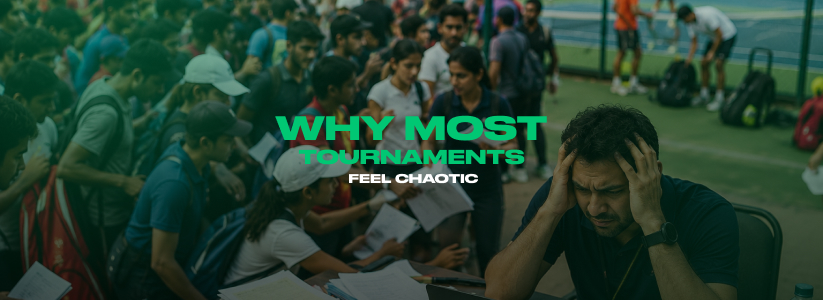
- Registrations come in through multiple informal channels — WhatsApp, phone calls, Google Forms — and the organizer spends hours compiling everything into a spreadsheet that is never fully accurate.
- Payments are collected without a proper record, leading to disputes, missed entries, and refund headaches.
- Draws are prepared manually, often the night before, with mistakes that only show up on match day.
- Communication relies on group chats, where important updates get buried under unrelated messages and not everyone sees what they need to.
- Results are tracked informally, with no clean record left behind after the event.
Each of these is a small failure on its own. Together, they create an event that feels patched together rather than planned.
Why the Right System Changes Everything
A proper tennis tournament management system does not just save time — it changes the quality of the entire event.
When registrations are handled through a dedicated platform:
- Every entry is recorded accurately from the moment a player signs up.
- Payments are tracked automatically, with a clear record of who has paid and who has not.
- Confirmations go out immediately, so players are never left wondering if their registration went through.
- The organizer has a real-time view of how many players are registered, per category, at any point.
When draws are generated by the system:
- Seedings are applied correctly, without manual calculation errors.
- Brackets are balanced, and scheduling conflicts are avoided.
- The draw is ready well before match day, giving players time to prepare.
When communication is managed through a platform:
- Players receive updates directly, without relying on them to catch a message in a busy group chat.
- Court assignments and match times are clear and accessible to everyone.
- The organizer is not the sole point of contact for every question on match day.
The difference in how the event feels — to players, to parents, to coaches — is significant.
What Players and Parents Actually Expect
Tennis players in India today are not comparing local tournaments only to other local tournaments. They are comparing them to the booking and event experiences they have on every other platform they use daily.
They expect:
- A registration process that takes a few minutes, not a back-and-forth over WhatsApp.
- An instant confirmation after they pay.
- A draw they can access on their phone, not a photo of a handwritten bracket.
- Timely updates about their match schedule, without having to ask.
These are not high expectations. They are the baseline that any well-run event should meet. The tournaments that meet them consistently are the ones that build a loyal base of players who come back every time.
How Tenniskhelo Brings Professional Standards to Every Tournaments
Tenniskhelo is built to give every tournament organizer in India access to the kind of system that professional events run on — without needing a large team or a big budget.
- Online registrations through a dedicated link, with automatic confirmations sent to every player.
- Integrated payments, so entry fees are collected and recorded in one place.
- Automated draw generation, with seedings and brackets handled by the platform.
- Real-time dashboards for organizers, showing registrations, payments, and match progress.
- Direct communication tools, so players get the information they need without the organizer having to send it manually to each person.
- Post-event data, including participation records and payment summaries that can be used for planning the next event.
Organizers who use Tenniskhelo spend less time managing admin and more time running a tournament worth attending.
The Standard Worth Aiming For
A professional tournament is not defined by its prize money or its prestige. It is defined by how well it is run and how the players feel when they leave.
When registrations work properly, when draws are fair and published on time, when matches run to schedule, and when players feel like the organizer has their experience in mind — that is a professional tournament.
The systems to make that happen are available. The only question is whether organizers choose to use them.