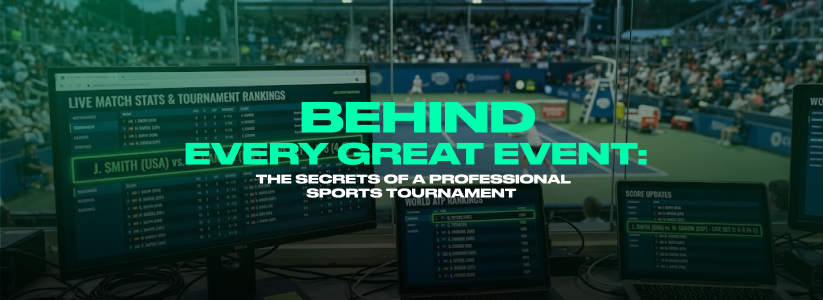
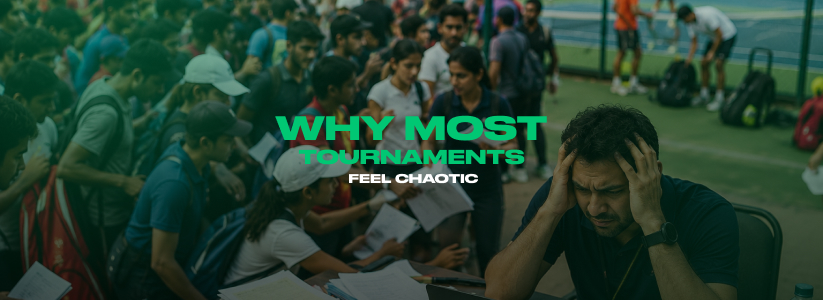
Watch a well-run professional sports tournament from the stands and nothing seems to be happening behind the scenes. Matches start close to time. Scores update. Players know where to be. It looks easy, the way a good magic trick looks easy — which is exactly the point. Nobody is supposed to see the work.
Watch a poorly run one and you’ll see the opposite: a coordinator running between courts with a clipboard, a draw that’s been crossed out three times, and a line of players asking the same question at once. The difference between the two isn’t talent or budget. It’s almost entirely about systems — the unglamorous, invisible infrastructure that decides whether an event runs itself or runs the organiser into the ground.
- 60%+ of organiser time in a manual tournament goes to chasing results and rebuilding the draw
- 3–4 Average withdrawals or walkovers per 32-player club draw
- 1 in 5 Matches typically affected by a schedule change on event day
The First Secret
A Good Draw Is Built Before the Tournament — Not Fixed During It
The single biggest predictor of how smoothly a tournament runs is decided days before the first serve: how the draw was built. A poorly seeded draw creates lopsided matches early and confusion later, when results don’t line up with expectations. A poorly structured draw means every withdrawal forces a manual rebuild — by hand, under pressure, while players are already waiting on court.
Professional sports tournament treat the draw as living infrastructure, not a printed document. It needs to absorb changes — a withdrawal, a walkover, a late entry — without falling apart.
The Invisible Workflow
What Actually Happens Behind a Smooth Tournament Day
From the outside, an event just runs. From the inside, here’s the sequence that’s quietly happening on repeat, match after match:
That entire loop has to run dozens of times across a single tournament day, often across multiple courts simultaneously. When even one step is manual — a coordinator walking over to ask the score, or updating a bracket photo by hand — the whole cycle slows down for every match behind it.
The Second Secret
The Best Organisers Plan for Chaos, Not Just for Order
Every experienced tournament director has the same quiet rule: assume something will go wrong, and build the event so it can absorb that without falling apart.
- Buffer time between matches: Matches that run long are normal, not exceptional. A schedule with zero slack collapses by the second round.
- A clear withdrawal protocol: Knowing exactly how a walkover updates the draw — automatically, not manually — saves hours across a multi-day event.
- Real-time communication, not group messages: Players and parents need schedule changes the moment they happen, not buried three messages deep in a chat thread.
- One source of truth for scores: When results live in a single, visible place, disputes about standings practically disappear.
- A connection to the bigger picture: Results that feed directly into a national ranking system mean the tournament matters beyond the trophy on the day.
Manual Coordination vs. Structured Systems: The Time Difference
The gap between an organiser running on instinct and one running on a structured system shows up most clearly in how their day is actually spent.
Notice what’s at the bottom of that list. In a manual setup, running the event — the part organisers actually signed up for — gets the least amount of their attention. Everything else crowds it out.
Where the Right Tools Change the Equation
What Changes When the Workflow Runs Itself
The six-step cycle described earlier — court assignment, notification, the match, scoring, draw update, next match — doesn’t have to be manual at any point. Tournament platforms built specifically for this purpose handle the entire loop automatically: a score entered after a match instantly updates the draw, the next match gets scheduled without anyone touching a spreadsheet, and the result flows straight into a player’s official ranking record without a separate step.
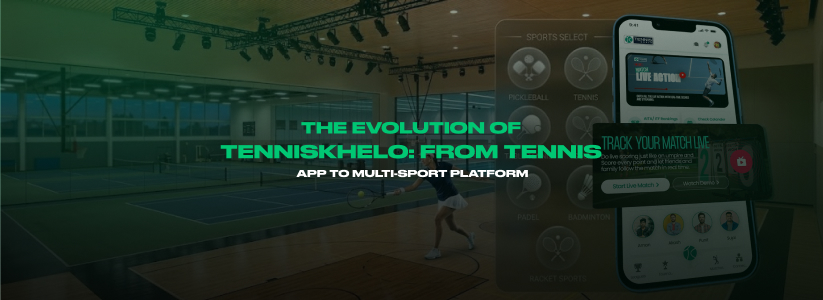
This is the quiet difference between a tournament that needs a small army of volunteers and one that needs a handful of people focused on actually running a good event. Platforms in this space — including Tenniskhelo, a tournament management app specifically around live draws, real-time scoring, and direct AITA ranking integration — exist precisely to take that six-step cycle off a human’s plate and let it run on its own.
The Underlying Principle
A professionally run tournament isn’t the one with the biggest budget. It’s the one where the system, not the coordinator, is doing the repetitive work — leaving the humans free to handle the things that actually need a human.
The Real Secret Isn’t a Secret at All
Behind every tournament that feels effortless is a structure built to absorb exactly the kind of chaos that derails the bad ones — withdrawals, schedule slips, late results. Nothing about that structure is glamorous. It’s draws that update themselves, scores that don’t need chasing, and rankings that connect without a delay.
A professional sports tournament aren’t the ones where nothing goes wrong. They’re the ones built well enough that when something does, nobody in the stands ever notices.
Frequently Asked Questions
1. What makes a sports tournament feel professionally organised?
A professionally organised tournament is defined by what participants never notice, having to think about — accurate draws, on-time scheduling, live score visibility, and clear results, all running quietly in the background without the organiser needing to intervene constantly.
2. What is the hardest part of running a professional sports tournament?
Most organisers point to two things: handling last-minute withdrawals or walkovers without disrupting the draw, and keeping every participant informed of schedule changes in real time without manually messaging each person.
3. How do tournament organisers handle scheduling conflicts?
Experienced organisers build in buffer time between matches, assign courts based on real-time availability rather than fixed slots, and use software that automatically reshuffles the schedule when a match runs long or a player withdraws.
4. Why do tournament results need to connect to official rankings?
Connecting tournament results directly to ranking bodies such as AITA removes delays and manual errors, giving players accurate, real-time visibility into how an event has affected their national standing.