From scattered courts and word-of-mouth coaching to a connected, data-backed sporting culture — racket sports in India are being rebuilt from the ground up
A racket sport, at its core, hasn’t changed in a hundred years. You hit a ball or a shuttle, your opponent hits it back, and someone runs off the court. What’s changed — and changed fast — is everything around that simple exchange: how players find a court, how they’re ranked, how a club runs its Saturday tournament, and how a teenager in a Tier 2 town discovers a coach worth training under.
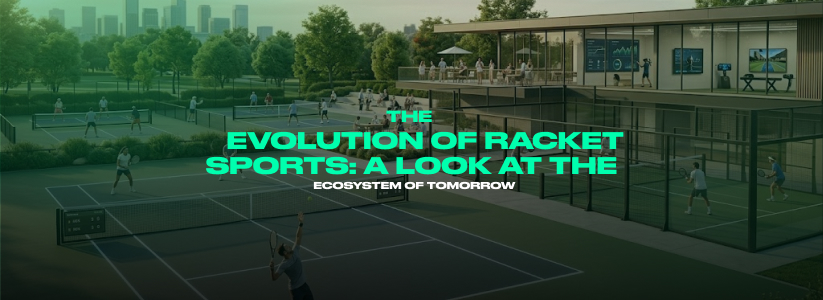
India is in the middle of rebuilding “everything around it.” Tennis, badminton, squash, table tennis, and the suddenly unavoidable pickleball are all being pulled into a more organised, more visible, more connected version of themselves. Here’s what that shift actually looks like.
Where We’ve Come From
Racket Sports in India Used to Run on Memory and Word of Mouth
Ask anyone who played club-level tennis or badminton a decade ago how they booked a court, found a tennis coach, or checked their ranking, and the answer usually involves a phone call, a personal connection, or a notice board. None of it was written down anywhere a stranger could find it.
That worked fine when racket sports were a smaller, tighter community. It stops working moment a sport grows and right now, almost every racket sport in India is growing at once.
The Shift Underway
Three Things Changing Across Every Racket Sport in India
- Court access is going digital. Searching for a court and academies near you and booking it on the spot — without a phone call or a club membership — has gone from rare to expected across cities of every size.
- Rankings are becoming visible, not mysterious. Players used to wait weeks to learn where a tournament result placed them nationally. Direct, real-time access to ranking bodies like AITA is closing that gap.
- Competition is becoming continuous, not occasional. Leagues, not just one-off tournaments, are giving players a reason to compete every week — which keeps people in the sport rather than playing twice a year and drifting away.
A Quick Snapshot
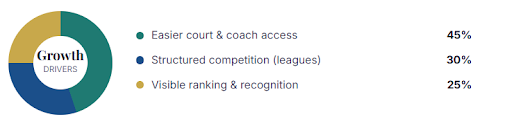
What’s Driving Growth Across Racket Sports Right Now
Different sports are growing for slightly different reasons, but three drivers show up again and again when you look across tennis, badminton, and pickleball alike.
Old Way vs. New Way
How Racket Sports Administration Has Changed
| Function |
A Decade Ago |
Now |
| Booking a court |
Phone call, club connection |
Search and book online instantly |
| Finding a coach |
Word of mouth only |
Searchable academy and coach listings |
| Tracking a ranking |
PDF lookup, weeks of delay |
Live, linked to tournament results |
| Staying competitive |
One or two tournaments a year |
Ongoing leagues and structured fixtures |
The Connected Future
What an Ecosystem Actually Means for a Racket Sports Player
An ecosystem isn’t a buzzword here — it’s a practical idea. It means a player’s entire journey, from booking their first court to checking a national ranking after a tournament win, lives inside one connected experience instead of five disconnected ones.
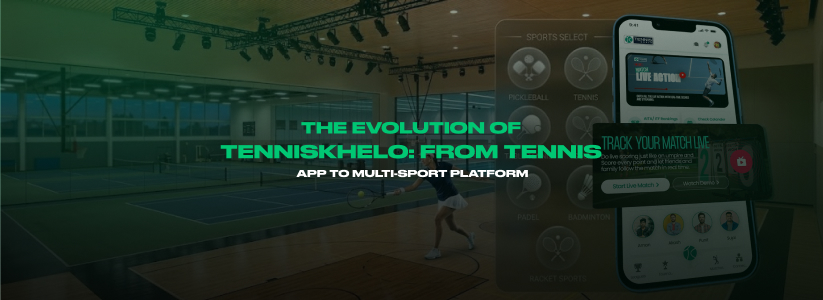
This is the direction tennis has moved in first among India’s racket sports, with platforms now linking court booking, tournament draws, academy discovery, and AITA ranking data under one roof rather than leaving each piece scattered across separate tools and phone calls. It’s a model other racket sports — badminton, squash, and the fast-rising pickleball — are likely to follow as their own player bases scale past what informal coordination can handle.
Worth Noting
The same underlying systems that manage a tennis draw or a court booking work just as well for any net sport. As pickleball and badminton scale up, expect the infrastructure built for tennis to extend outward rather than be reinvented from scratch.
The Next Few Years Will Decide Who Builds This Properly
Racket sports in India aren’t short on players, courts, or enthusiasm anymore. What’s being built right now is the connective layer underneath all of it — the part that turns a fragmented hobby into a real sporting ecosystem with visible rankings, organised competition, and accessible infrastructure for anyone willing to pick up a racket.
The sport on the court hasn’t changed in a hundred years. What’s finally catching up is everything that happens before a player even steps onto it.
Frequently Asked Questions
-
What counts as a racket sport?
Tennis, badminton, squash, table tennis, and pickleball are all racket sports — games played with a handheld implement against an opponent across a net or wall, distinguishing them from stick sports like hockey or bat sports like cricket.
-
Why are racket sports growing faster in India now?
Urban space constraints, rising disposable income, and a cultural shift toward fitness as a lifestyle have pushed racket sports into apartment complexes and corporate campuses, while digital platforms have made courts, coaching, and competition far easier to access than before.
-
What does a connected racket sports ecosystem look like?
A connected ecosystem links court booking, tournament management, coaching discovery, and official rankings under one digital structure, so a player’s entire competitive journey — from a casual booking to a national ranking — is visible in one place.