The order of play is the single document a tournament runs on. It tells every player when to be on court, every official where to go, every volunteer which match to cover, and every spectator which court to stand at. With the help of modern Order of Play Software, organizers can create and share this schedule more accurately and efficiently.
When it is accurate, comprehensive, and available early enough for everyone to plan around it, a tournament gains an authority it cannot build any other way. When it is not, every part of the event feels uncertain from the opening match to the closing ceremony.
1. What the Order of Play Actually Has to Manage
The phrase order of play sounds simple — a list of matches and times. In practice, it is one of the most constraint-heavy documents in sport. A multi-court, multi-category tournament involves dozens of interdependent variables that cannot be resolved sequentially. They all have to be resolved simultaneously.
Rest time between a player’s matches. Court availability as matches run long or finish early. The physical impossibility of a player being on two courts at once. Broadcast obligations for featured matches. Junior draw phases sharing courts with senior events. Referee and umpire availability across sessions. Each of these constraints interacts with the others, and a change to any one of them ripples through the rest of the schedule.
Smart scheduling software holds all of these constraints in memory at once and validates every match assignment against all of them before it is placed in the schedule. The result is an order of play that is not just logistically possible — it is legally correct under the tournament’s own rules before it is published.
WHAT SMART ORDER OF PLAY SOFTWARE ACTUALLY MANAGES
1. Player Rest Enforcement
The system blocks any match assignment that violates the minimum rest window — typically 30 to 60 minutes between matches. Applies automatically across singles, doubles, and mixed categories when a player appears in more than one.
2. Court Conflict Prevention
Every court assignment is validated against all existing bookings in real time. Two matches cannot be scheduled to the same court at the same time — the system physically prevents it before the schedule is published.
3. Real-Time Match Clock Integration
As a live match runs longer than estimated, the software updates remaining court availability automatically. The following matches shift to reflect actual finish time, not a projected one.
4. Cross-Category Player Tracking
A player entered in both singles and doubles is tracked as a single scheduling entity. Both match assignments are visible together, and any overlap is flagged and resolved before the order of play is confirmed.
5. Priority Queue Management
Show courts, centre courts, and broadcast-priority matches are placed in a dedicated priority queue. Seeded players and marquee matchups get scheduled on the right courts, at the right times, without manual intervention.
6. Automatic BYE and Withdrawal Handling
When a player withdraws, the system rebrackets, reassigns courts, and updates the order of play across all affected rounds. Every participant sees the corrected schedule before any match is called.
2. How It Changes Tournament Day Operations
The operational difference between a tournament run on manual order of play management and one using automated scheduling software is felt at every level of the event, from the moment the schedule is published to the final trophy handover.
When the order of play is generated manually — built court by court, round by round, with individual calendar checks for every player appearance — it typically takes three to five hours for an experienced organiser to complete for a 64-player event. That same schedule, with the same variables and the same constraints, is generated in minutes by dedicated software. And unlike the manual version, the software’s output is conflict-checked against every constraint simultaneously, not sequentially.
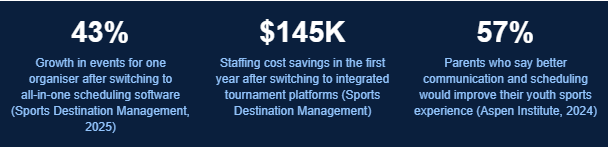
The downstream effect on tournament operations is significant. Sports organisers who previously ran two events per weekend have reported managing six or more with the same staff size after switching to integrated platforms. One operator reported $145,000 in staffing cost savings in the first year — not because they cut people, but because the tools stopped requiring the same volume of manual oversight on the day.
| Area of Impact |
What Smart Order of Play Delivers |
| Player experience |
Clear match times, fair rest, and no court confusion from Day 1 |
| Court utilisation |
Every court runs at maximum productive capacity throughout the day |
| Organiser workload |
Order of play generated and published in minutes, not hours |
| Broadcast/media |
Reliable timing windows for any coverage, streaming, or promotion |
| Sponsor confidence |
Predictable schedule supports activation planning and visibility |
| Repeat participation |
Players trust a well-run event and return for the next edition |
3. The Player Experience That Flows From a Clean Schedule
Every improvement in order of play management is felt first by the players — and what they feel determines whether they enter the next edition of the event.
A smart order of play gives players match times they can trust. It confirms court assignments before they travel to the venue. It communicates changes the moment they happen, through one channel, in one place. The Aspen Institute’s 2024 research found that 57 percent of parents said better communication and scheduling would improve their youth sports experience — which means that nearly three in five families are noticing the gap between what a good schedule provides and what most events currently deliver.
Predictable scheduling also protects player performance. Mandatory rest windows enforced by software mean that a player who finishes a hard singles match at 11:30am is not called to a doubles court at 11:45am. That protection compounds across a tournament day — players who are well-rested perform better, which produces better competition, which builds the event’s reputation faster than any promotional effort could.
4. Where This Works in Practice
| |
TennisKhelo — India’s all-in-one racquet sports management platform — integrates order of play directly into its tournament draw and scheduling system, with every match carrying its court number, venue, and time as part of the same screen players use to check the bracket. Over 10,000 organisers across Indian tennis have used the platform to run events where the schedule, the draw, and the live scores are managed in one place — giving players and officials a single source of truth from the first published order of play to the final result. |
5. What Makes Order of Play Software Genuinely Smart
Not all scheduling tools meet the bar implied by the word smart. The distinction lies in how the software handles constraints it did not anticipate at setup time.
A genuinely intelligent order of play system does three things that static scheduling tools do not. It updates the schedule in real time as match durations vary from estimates. It handles mid-tournament changes — withdrawals, walkovers, late withdrawals — by automatically recalculating the entire order of play rather than requiring manual adjustment to every affected slot. And it publishes those changes immediately to every participant through the same platform they used to register and check their draw.
The outcome is a tournament schedule that is not just correct at the moment of publication. It stays correct throughout the event — because the software continues managing it, rather than treating publication as the end of the scheduling process. That is the operational improvement that smart order of play software delivers, and it is the standard every modern tournament deserves to run on.
A great order of play is invisible to most people who benefit from it. Players know their court time, coaches plan warm-ups, officials arrive on schedule, and spectators choose which match to follow — all without knowing how many constraints were resolved to make the afternoon feel that straightforward. That invisibility is what smart software is built to create.