Ask a parent what they remember about watching their child play in a tournament, and one of the first things they mention is checking their phone for live scoring updates. Not for messages—for the live score. Whether they are sitting in the stands just a few metres away or driving home three hours later, the instinct is the same. People want to know what is happening the moment it happens.
Live scoring technology was built for that instinct. And in 2025, it is no longer a premium feature reserved for professional circuits. It is the baseline expectation at any tournament that takes its participants seriously — and the standard that separates a professional event from an amateur one in the eyes of every player, parent, coach, and sponsor who shows up for it.

1. What Live Scoring Actually Means for a Tournament
People often use the term live scoring loosely, so it’s important to understand how it works in a professional tournament. As soon as a match ends, the official enters the score on a courtside device. The system instantly updates the result, allowing players, organizers, and anyone following the draw to see the latest score in real time—without any extra steps or delays.
Tournament staff enter scores directly into the system instead of posting them in WhatsApp groups or updating spreadsheets manually. It is a direct, instantaneous connection between a point played on court and information published to every stakeholder at the same moment.
That difference — between real-time score updates and delayed manual entry — is not cosmetic. It changes the texture of the entire event. The bracket becomes a live document rather than a historical record. The organiser stops being a bottleneck for information. The spectator experience becomes genuinely engaging rather than a guessing game.
| HOW LIVE SCORING WORKS: FROM FINAL POINT TO PUBLISHED RESULT |
| STEP 1 Match ends on court — Umpire or designated scorer opens the app on their phone |
| STEP 2 Score entered immediately — Set scores, game scores, and match winner confirmed in the app |
| STEP 3 Data submits in real time — Result transmits to the tournament server the moment it is saved |
| STEP 4 Bracket auto-advances — The next round match is created automatically — no manual step |
| STEP 5 Rankings sync overnight — Federation ranking systems receive the result via API integration |
| STEP 6 Player notified — Push notification confirms result to both players instantly |
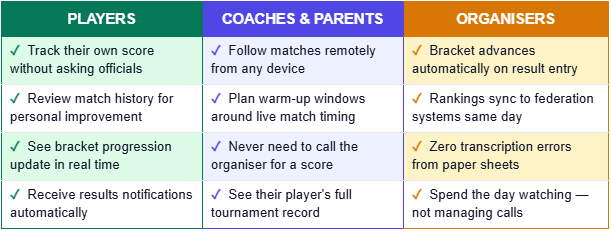
2. How Live Scoring Changes the Experience for Everyone
Live scoring technology benefits are not felt equally by all groups at a tournament — they are specific to how each group interacts with match information. But the overall effect is the same across all of them: the tournament becomes more transparent, more trustworthy, and more enjoyable to participate in.
3. The Technical Benefits That Go Beyond the Scoreboard
The most visible benefit of live tournament scoring is immediate information. But the technical gains that flow from it extend well beyond what any individual spectator sees.
When a result enters the system in real time, the tournament bracket advances automatically.
There is no lag between when a match finishes and when the next round’s matchup is confirmed. Players know who they face next before they have finished shaking hands with their last opponent. Court assignments for the following round are available the moment the previous one ends.
Ranking updates follow the same logic. Platforms that integrate directly with national federation systems — AITA, TTFI, WSF, or state federation databases — can push match outcomes to official player rankings within hours of the final result. Players who competed on Saturday morning see their updated standing on Saturday evening. That immediacy is part of what makes an event feel legitimate, not just well-run.
There is also a data dimension. Every score entered through a live scoring platform becomes a data point — accessible after the event for analytics, historical record, and performance review. Organisers who run multiple editions of the same tournament accumulate a dataset that informs future seeding, category sizing, and scheduling decisions. That turns a single event into a compounding asset.
The global sports software market was valued at $3.8 billion in 2021 and is projected to reach $12.6 billion by 2031, driven almost entirely by the adoption of real-time data infrastructure at the club and event level. Live scoring is a primary driver of that growth.
4. Live Score as Part of a Complete Platform
Live scoring software is most powerful when it is not a standalone tool. When scoring integrates with registration, draws, scheduling, rankings, and communication in the same system, every part of the event becomes more coherent. Tournament officials enter the result on the court, and the system automatically updates every connected platform without requiring manual transfers.
LIVE SCORING IN TENNISKHELO
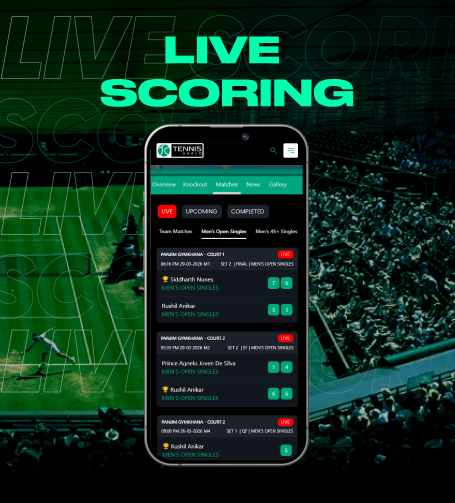 TennisKhelo, India’s all-in-one racquet sports management platform, brings live scoring directly into its tournament home screen. Players and parents can catch all live action with real-time scores and streaming — all from the same app they use to register, book courts, and check AITA rankings.
- Live match scores visible from the home screen without switching apps
- AITA / ITF rankings update automatically as results are confirmed
- Integrated alongside court booking, draw management, and academy discovery
This kind of integration is what turns live scoring technology from a convenience into infrastructure. The event does not just feel more professional — it is more professional, in the most technical sense of the word: every system is talking to every other system, in real time, without human intervention between the point scored and the result published.
A tournament that publishes live scores is a tournament that respects the people who entered it. It tells players their match matters enough to track in real time. It tells parents their journey to the venue was worth taking seriously. And sponsors and federation officials that the event operates at a standard worth backing. That is not a technology argument. It is a credibility argument — and live scoring technology is the simplest way to make it.