
How Sports Tournament Software Makes Live Scoring Fast, Accurate, and Reliable

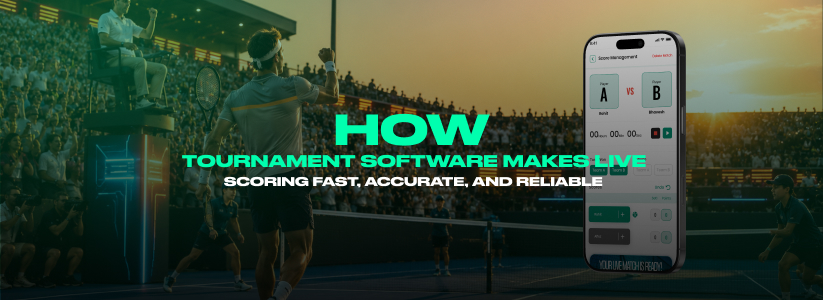
How Sports Tournament Software Makes Live Scoring Fast, Accurate, and Reliable

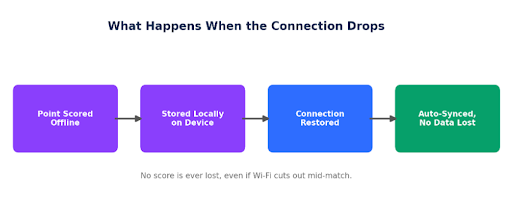
The Wi-Fi went down at a regional sports tournament I was following online, right in the middle of a tiebreak. I remember refreshing the page, expecting the score to have frozen mid-match, maybe lost entirely. Instead, the second the connection came back, the score jumped straight to where it actually was — every point accounted for, nothing missing. Someone had clearly built that system assuming the internet would fail at some point, because it did, and it didn’t matter.

That’s the part people rarely think about when they talk about Live Scoring. Everyone notices when it works smoothly. Almost nobody notices the engineering that goes into making sure it doesn’t fall apart the moment something goes wrong.

Fast Isn’t Just a Nice Feature

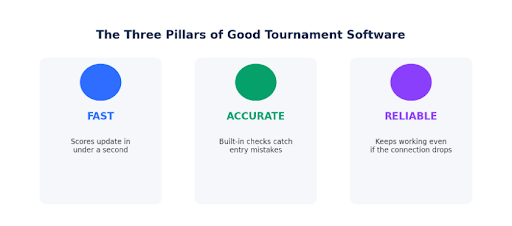
Speed sounds like the obvious selling point, and it is one, but it’s worth being specific about what “fast” actually means here. Live Scores that update within a second of a point being played aren’t just satisfying to watch — they’re functionally necessary. A scoreboard that lags ten or fifteen seconds behind real play creates confusion about what’s actually happening, especially in close matches where the score is changing rapidly.

Tournament Software

Good Sports Tournament Software treats speed as a baseline requirement, not a bonus feature. The moment a point gets logged, everything downstream — the scoreboard, the bracket, anyone watching remotely — needs to reflect that instantly, or the whole point of live tracking falls apart.

Accuracy Is Where Most Systems Quietly Fail

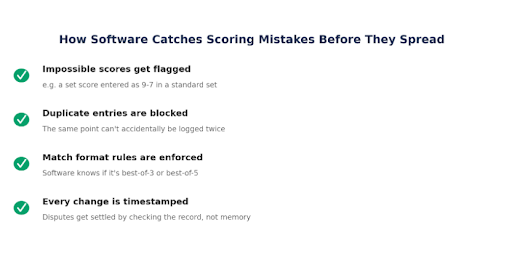
Speed without accuracy is almost worse than no live scoring at all, because a fast, wrong number spreads confusion faster than a slow, correct one. This is where the actual engineering behind Tournament Live Scoring earns its keep.

tournament live score

A well-built system won’t accept a score that’s mathematically impossible for the format being played — it knows the difference between a standard set and a match tiebreak, for instance, and rejects entries that don’t fit. It also blocks the same point from being logged twice, which sounds like a small thing until you’ve watched a scoreboard visibly jump because of a double-tap. And every change carries a timestamp, which turns “I’m pretty sure that’s wrong” into something that can actually be checked and settled in seconds.

Reliability Is the Part Nobody Sees Until It’s Tested

This is the pillar that matters most and gets talked about least. Venues have bad Wi-Fi. Devices lose signal mid-match. A system that only works under perfect conditions isn’t really live scoring — it’s a demo that happens to work most of the time.

tournament live scoring app

Real-Time Score Updates that are actually built to last don’t just assume a stable connection. They store entries locally the instant something’s logged, then sync automatically the moment connectivity returns, without anyone needing to notice a gap ever happened. That’s the difference between sports tournament software that looks good in a controlled demo and software that survives an actual tournament weekend at a venue with patchy signal in the corner courts.

Read Also: “How to Share Live Tennis Scores with Anyone with TennisKhelo App

Why This All Matters for Sports Tournament Management

None of this is really about scoring in isolation. Once results are fast, accurate, and reliable, everything else built around Sports Tournament Management gets noticeably steadier — brackets update correctly, schedules reflect real match pace, and disputes get resolved with an actual record instead of someone’s memory of what happened three matches ago. Weak scoring infrastructure doesn’t just create a bad spectator experience; it creates ripple effects that touch scheduling, seeding, and even how much organizers can trust their own data by the end of the day.

A Small But Telling Detail

Here’s something that doesn’t get mentioned often: a lot of the trust in Live Scoring Technology comes down to how it handles edge cases nobody plans for — a match suspended for weather, a retired player, a scoring correction after a review. Systems that treat these as afterthoughts tend to produce messy, inconsistent records. The better platforms design for them from the start, which is part of why sport-specific tools tend to outperform generic ones.

Tenniskhelo’s Live Scoring App is a good example of getting this right — built specifically for tennis, it already understands sets, tiebreaks, and retirements as first-class scenarios rather than exceptions bolted on after the fact.

The Bottom Line

Fast, accurate, and reliable sound like three separate goals, but in practice they depend on each other. Speed without accuracy just spreads wrong information quickly. Accuracy without reliability collapses the moment a connection drops. It’s the combination that actually earns a tournament’s trust — and once organizers experience sports tournament software that gets all three right, going back to anything less starts to feel like a genuine risk rather than a minor inconvenience.

Share

Popular Posts