
The Role of Automatic Rankings in Professional Tournament Management

The Role of Automatic Rankings in Professional Tournament Management

A circuit administrator once described her old job to me as “air traffic control with a clipboard.” She was responsible for consolidating results from six regional tournaments into one national list, by hand, every single week. One missed email from a regional organizer, and a player’s entire ranking could sit wrong for days, sometimes affecting a seeding decision before anyone caught the mistake. That’s the kind of quiet risk Automatic Rankings in Professional Tournament Management were built to eliminate — not by working harder, but by not requiring a human to be the connective tissue between every event and the final number.


Why Automatic Rankings Matter in Professional Tournament Management

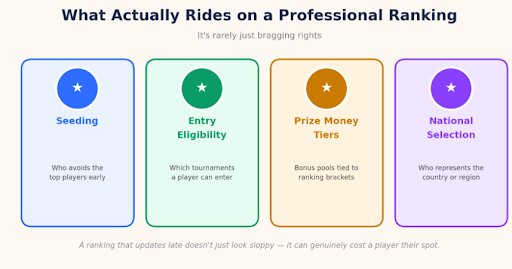
At a club level, a ranking mistake is mildly annoying. At a professional level, it’s a different problem entirely. A Tournament Ranking System feeding into national or international circuits doesn’t just tell a player where they stand — it can determine which events they’re even eligible to enter next, how they’re seeded against the field, and in some cases whether they qualify for funding tied to performance benchmarks. There’s very little room for a number that’s slightly out of date.

Automatic Rankings

Every Level of Play Feeds the Same Number

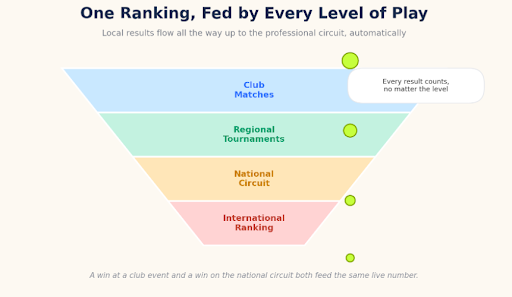
One detail that surprises people outside competitive sport: a result from a small regional sports tournament and a result from a major national event both flow into the same ranking calculation, just weighted differently. Good Tournament Management Software is built to absorb results from every tier of an event structure without someone manually reconciling six separate spreadsheets into one master list.

Automatic Rankings System

What Real-Time Actually Means at This Level

At the professional tier, waiting even a few days for a ranking update isn’t a minor inconvenience — it can affect a seeding decision for a tournament happening that same week. Real-Time Tournament Rankings solve this by recalculating positions the moment a result is confirmed, rather than batching updates into a weekly or monthly cycle that always lags slightly behind reality.

An Interesting Detail From How Circuits Actually Run

Something worth knowing: most professional circuits use a rolling window rather than a single season total, meaning older results gradually drop off as new ones are added. Calculating that by hand, across hundreds of players and a constantly shifting time window, is genuinely impractical at scale. An Automated Ranking System handles the rolling math continuously, so a player’s number always reflects their most relevant recent form rather than a stale full-career total.

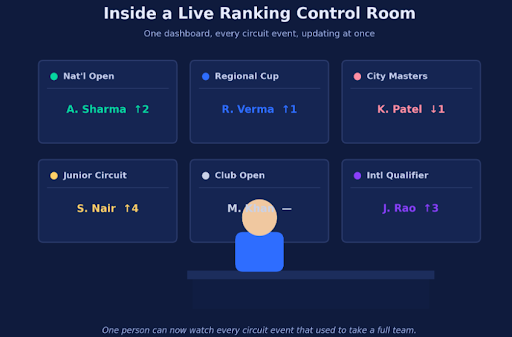
One Dashboard, Every Event at Once

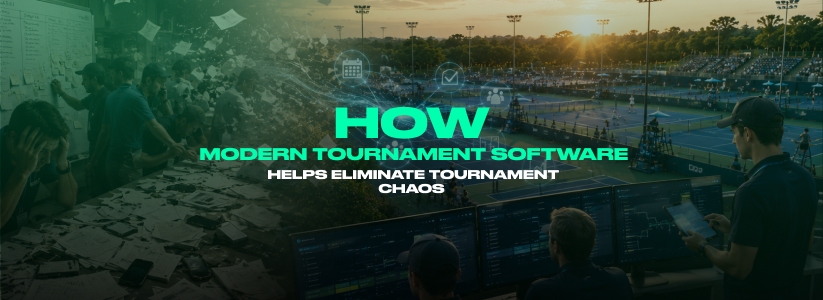
Modern ranking platforms increasingly function like a control room, letting a small administrative team monitor an entire circuit’s worth of events simultaneously instead of chasing results event by event.

live ranking control

Why This Matters for the Bigger Picture

Rankings don’t operate in isolation at the professional level. They’re deeply woven into Sports Tournament Management as a whole — influencing wildcard decisions, funding allocations tied to performance tiers, and national team selection processes that depend on an accurate, current snapshot of form.

Sport-Specific Systems Matter More at This Level

Generic ranking tools tend to fall apart under professional complexity — multiple formats, doubles and singles combined, retirements, walkovers, and circuit-specific weighting rules. Tenniskhelo’s Automatic Rankings system is built specifically around these tennis-specific scenarios, which matters far more at the professional level than it does for a casual weekend event.

The Bottom Line

Professional tournament management runs on trust in the numbers — seeding committees, selectors, and players all need to believe the ranking in front of them is current and correct. Once that trust is automated rather than manually assembled from six spreadsheets and a handful of emails, the entire circuit runs with fewer disputes, fewer delays, and a lot less risk riding on one overworked administrator’s inbox. It stops being a fragile weekly ritual and starts being infrastructure the whole circuit can actually depend on.

Share

Popular Posts