

How Modern Sports Tournament Software Helps Eliminate Tournament Chaos

How Modern Sports Tournament Software Helps Eliminate Tournament Chaos

Turning registration errors and scheduling conflicts into problems that never reach the court

Every organizer knows the feeling: a tournament that looked perfectly planned on paper starts unraveling by mid-morning. A registration error surfaces, a court gets double-booked, and suddenly staff are firefighting instead of running the event. Sports tournament management software exists to interrupt exactly this kind of chain reaction, catching small problems before they snowball into visible chaos.

What makes tournament chaos particularly frustrating is how preventable most of it actually is. The same handful of failure points — bad entries, scheduling clashes, and poor communication — show up again and again, which means they’re solvable with the right system rather than something organizers simply have to accept as part of running an event.

Chaos Rarely Starts Where You See It

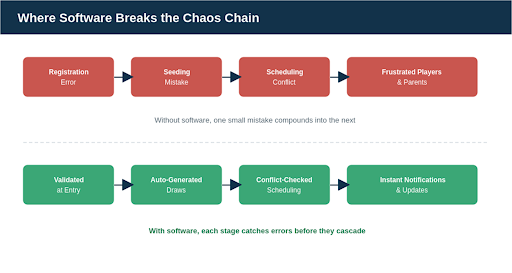
The confusion players and parents notice on tournament day — a wrong court, a missed match, a delayed draw — is almost always the end result of a mistake made much earlier. A single unvalidated registration or a manually built draw can set off a chain that only becomes visible once it reaches the court.

By the time that chain reaches the court, it’s usually too late to fix quietly. What could have been a two-minute correction during sign-up becomes a public disruption in front of players, parents, and officials.

Modern Sports Tournament Software tennis khelo

Without software, one small error compounds into the next — good tournament software catches it at every stage instead.

One System, Fewer Points of Failure

The biggest shift modern tennis tournament apps bring isn’t a single feature — it’s consolidation. Registration, draws, court scheduling, and notifications used to live in separate spreadsheets, group chats, and printed sheets. Bringing them into one connected system means an error caught during sign-up never gets the chance to become a scheduling conflict three weeks later.

Every extra tool or handoff between systems is a place where information can go stale or get lost entirely. Reducing that number to one connected platform doesn’t just simplify life for organizers — it removes several of the actual points where chaos used to creep in.

Right tournament management software

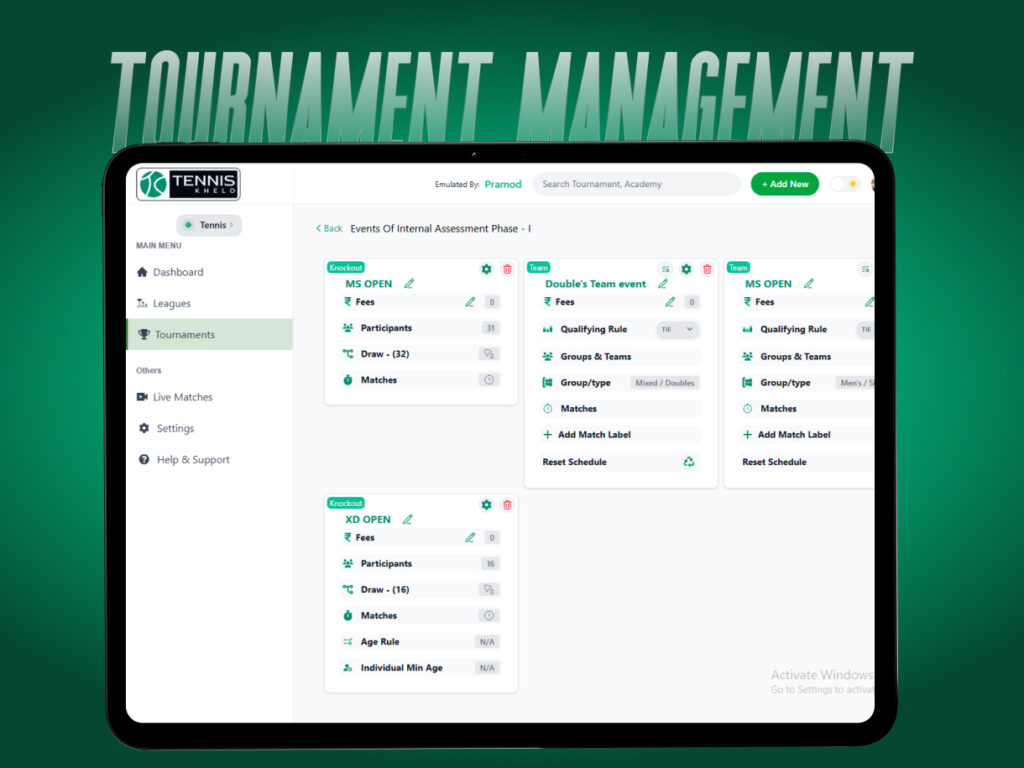
A single control center gives organizers one live view of registrations, draws, courts, and notifications.

What Changes on the Ground

Validated Registrations

Online forms instantly identify duplicate entries, missing details, and category mismatches as players submit their registrations instead of leaving organizers to find them days before the tournament.

Read Also: “10 Tournament Registration Mistakes That Can Disrupt Your Event


Conflict-Free Draws and Courts

Automated draw generation and live court dashboards flag double-bookings before they happen, replacing the guesswork of manual scheduling with a system that checks every assignment against real constraints.

Real-Time Communication

Push notifications replace noticeboards and phone calls, so players and parents always see the current schedule, not the one printed that morning.

Manual process vs tournament software process

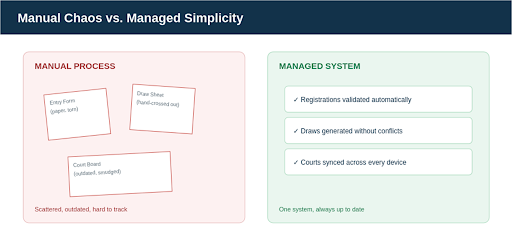
Scattered paper processes versus a single, always-current managed system.


Bringing It Together

This consolidated approach is exactly what’s driving adoption of integrated platforms among Indian tennis organizers. Tenniskhelo brings registration, draw management, and court scheduling into one system, so an error caught early has no chance to cascade into the kind of chaos that used to define tournament day.

For academies running multiple events across a season, this consistency matters as much as any single feature — organizers, umpires, and players all learn one system instead of relearning a new process for every tournament.


Final Thoughts

Tournament chaos isn’t inevitable — it’s usually the visible symptom of small problems that went uncaught for too long. Modern tournament scheduling software doesn’t just organize an event; it interrupts the chain reaction before it starts, giving organizers, players, and parents a tournament experience that actually matches the planning that went into it.

The organizers who make this shift usually notice the difference immediately — fewer disputes at the help desk, fewer last-minute reshuffles, and an event that feels as controlled behind the scenes as it looks on the court.

Share

Popular Posts