Anyone who has organized a tennis event knows the headache that comes right after registrations close: the schedule. Matching players to courts, avoiding back-to-back conflicts, working around weather delays, and keeping everyone informed used to mean hours hunched over spreadsheets and whiteboards. Today, tennis tournament management software has completely changed how organizers handle this once-painful process, turning chaotic court allocation into a smooth, predictable system.
The Real Cost of Manual Court Scheduling
 Before digital tools became common, tournament directors relied on paper draws, printed sheets pinned to noticeboards, and a lot of guesswork. A single rain delay could throw off an entire day’s schedule, forcing organizers to manually recalculate match timings across dozens of courts. Players would show up not knowing when or where they were playing, umpires would double-book themselves, and academies hosting multiple age categories on the same weekend often ran into overlapping court usage. These aren’t small inconveniences — they directly affect player experience, event reputation, and the willingness of sponsors or academies to return for future editions. This is exactly the gap that court scheduling software and tennis tournament apps were built to close.
How Tournament Software Solves the Problem
1. Real-Time Court Availability
The biggest advantage of online tennis tournament software is visibility. Instead of checking a paper chart, organizers get a live dashboard showing which courts are occupied, free, or reserved for maintenance. This single view eliminates the double-booking errors that plague manual systems and lets staff reassign matches in seconds rather than minutes.
2. Automated Draw and Match Allocation
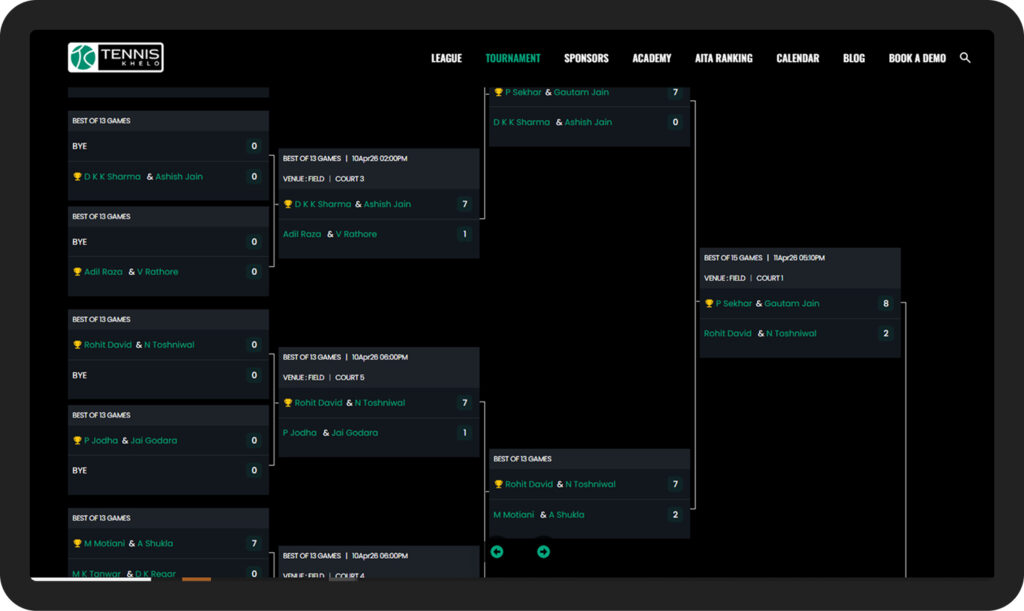
Good scheduling software doesn’t just track courts — it actively builds the draw around them. Once player entries, seedings, and match formats are entered, the system automatically distributes matches across available courts and time slots, factoring in rest periods between matches, category groupings, and umpire availability. What used to take an organizing committee an entire evening now takes a few clicks.
- Instant Rescheduling During Delays
Weather interruptions, retirements, and walkovers are part of tennis. The difference with digital tournament scheduling tools is how fast the system adapts. A rain delay that once meant re-drawing an entire day’s schedule by hand can now be resolved with a few taps — the software recalculates court assignments and instantly notifies affected players, coaches, and umpires through push notifications or SMS.
4. Reduced Human Error
Manual scheduling is prone to oversights — a player accidentally listed on two courts at once, a category missing from the day’s plan, or an umpire assigned to overlapping matches. Automated systems cross-check every assignment against existing bookings, flagging conflicts before they become on-court problems. This kind of built-in validation is something spreadsheets simply cannot offer at scale.
5. Better Communication with Players and Parents
One of the most underrated benefits of tennis scheduling apps is communication. Instead of players calling organizers to ask “what time do I play?”, the app sends live updates directly to their phones. Parents accompanying young players particularly benefit from this, since they can track match timings remotely instead of waiting around courts for hours.
Why This Matters for Academies and Organizers
For tennis academies running multiple leagues alongside major tournaments, court scheduling conflicts can quickly snowball if not handled digitally. Software that combines court booking, tournament draws, and live updates into a single platform gives academies the ability to run several events simultaneously without operational chaos. This is where platforms like Tenniskhelo have become valuable for Indian tennis organizers — offering integrated court booking, tournament management, and real-time scheduling tools designed specifically for the local tennis ecosystem.
The Bigger Picture: From Chaos to Consistency
The shift from paper-based scheduling to software-driven systems isn’t just about convenience — it reflects how tennis events are expected to run today. Players and parents increasingly compare local tournaments to professional ones, where live scores, accurate timings, and instant updates are the norm. Organizers who continue relying on manual court allocation risk falling behind those offering a smoother, tech-enabled experience.
Tournament management software brings structure to what was once one of the most stressful parts of running an event. By automating court allocation, enabling real-time adjustments, and keeping every participant informed, it removes the guesswork that historically caused delays, disputes, and frustrated players.
Final Thoughts
Court scheduling issues have long been the silent disruptor of tennis tournaments — invisible until something goes wrong, and then impossible to ignore. With the rise of tennis court booking software and automated draw systems, organizers finally have the tools to prevent these problems before they start. Whether you’re managing a weekend club event or a multi-day AITA-ranked tournament, adopting the right scheduling technology isn’t just a convenience anymore — it’s what separates a professionally run event from a chaotic one