
Stress-Free Tennis Event Planning: A Complete Guide for Organizers

Stress-Free Tennis Event Planning: A Complete Guide for Organizers

Every tennis tournament organizer remembers their first event a little too well. Effective tennis event planning can be challenging, especially when the registration list doesn’t match the draw, the phone won’t stop buzzing, and two matches accidentally end up scheduled on the same court at the same time. None of it is caused by bad luck. It is usually the result of decisions that were made too late, or not made at all.

Stress-free tennis event planning isn’t about avoiding every possible problem. It’s about deciding things early enough that the problems which do show up have somewhere safe to land. Here’s a complete, practical guide to doing exactly that.


Your Planning Countdown

What to Lock In, and When, Before the First Serve

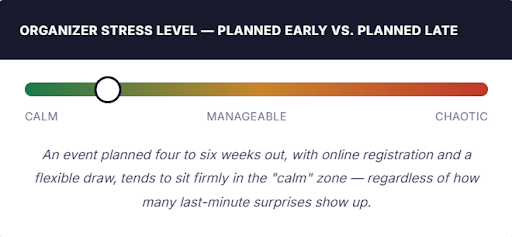
Most tennis tournament stress traces back to one root cause: too many decisions bunched up in the final week. Spreading them out, as below, removes almost all of it.

Stress-Free Tennis Event Planning A Complete Guide for Organizers

The Organizer’s Checklist

Everything Worth Confirming Before Registration Opens

Pre-Tournament Checklist

  • Venue & courts confirmed — including a backup plan for weather or last-minute unavailability.
  • Categories clearly defined — age groups, skill levels, singles or doubles, stated without ambiguity.
  • Registration process set up online — with a clear entry deadline communicated up front.
  • Withdrawal policy decided in advance — so a late dropout doesn’t require an on-the-spot decision.
  • Buffer time built into the schedule — assuming at least one match will overrun.
  • A system for live scoring — so results don’t depend on someone remembering to report them.
  • A plan for ranking submission — if the event counts toward AITA or another official standing.

Read Also: “The Ultimate Guide to Organizing a Successful Tennis Event Planning


The Mistakes That Cause the Most Stress

Three Tennis Event Planning Habits Worth Breaking Immediately

  • Opening registration too late: A rushed sign-up window leads to incomplete entries, missing category details, and a draw built on shaky data.
  • Scheduling with zero slack: One overrunning match at 10 a.m. shouldn’t be allowed to derail every match scheduled after it.
  • Treating scoring as an afterthought: Waiting until the end of the day to collect results turns the final hour into a scramble nobody enjoys.


Making the Plan Actually Hold

Why a Good Plan Still Needs the Right Tools Behind It

A checklist and a countdown will get an organizer most of the way there. What closes the remaining gap is having registration, the draw, scheduling, and scoring live inside one connected system — so that a decision made in week four doesn’t get lost by the time week one arrives.

Tenniskhelo is exactly the kind of platform India’s tennis tournament organizers have started leaning on more — one built specifically around the country’s club tournament structure, where signing players up, generating the draw, tracking live scores, and feeding results into an AITA ranking all happen without switching between five different tools. 


The Practical Takeaway

A stress-free tournament isn’t the result of having fewer things to manage. It’s the result of managing everything from one place, so nothing slips through a gap between tools.

Planning Early Is the Whole Secret

There’s no version of tennis event planning that removes every surprise — a tennis player will always withdraw at the worst possible time, a match will always run long. The goal was never a perfect day. It was a day where every surprise has a place to go that doesn’t involve the organizer panicking in a corner.

Stress-free planning isn’t about doing more. It’s about deciding the right things early enough that, by the time the tournament actually starts, there’s almost nothing left to decide.


Frequently Asked Questions

How far in advance should I start planning a tennis tournament?

Most experienced organizers begin planning four to six weeks before a club-level tournament, allowing enough time for venue confirmation, registration, and draw preparation without last-minute pressure.

What is the most common mistake in tennis tournament planning?

The most common mistake is building a fixed schedule with no buffer time between matches, which causes a single delayed match to disrupt every match scheduled afterward.

Should tennis tournament registration be done online or offline?

Online registration is strongly recommended because it captures player category and contact details accurately from the start and avoids the confusion of tracking entries through phone calls or messages.

Share

Popular Posts