Every tournament organiser knows the feeling — a perfectly planned schedule unravelling by 10 a.m. because one match ran long and nothing could adjust in time. Smart automation exists to end exactly that.
There is a specific kind of stress that comes with running a tournament manually. It is not the drama of a close final or a surprise upset — those are exciting. It is the quiet panic of a double-booked court, a player who withdrew whose name is still in the bracket, or a schedule built two hours ago that no longer reflects anything happening on the ground. Smart tournament scheduling automation was built specifically to remove that panic from the equation.
The technology is not complicated to understand. It is complicated to build — but for the organiser using it, the experience is simply that things work. The bracket updates. The court clears. The next player is notified. And the organiser gets to focus on running an event rather than managing a crisis.
The Real Cost of a Scheduling Conflict Nobody Caught in Time
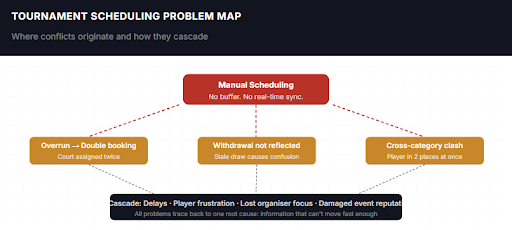
Scheduling problems are not simply inconvenient. They are expensive in the currency that matters most on a tournament day — organiser attention. The moment a conflict is discovered, the organiser’s focus shifts entirely to resolving it. While that single problem is being fixed, every other part of the event operates without active oversight. Courts go unmonitored. Players go without updates. The rest of the schedule starts slipping.
This is the actual cost of scheduling conflict resolution in sports done manually: it demands exactly the resource that was already fully allocated.
How Smart Automation Solves Each Problem at Its Source
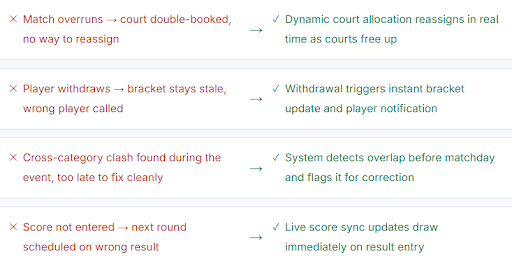
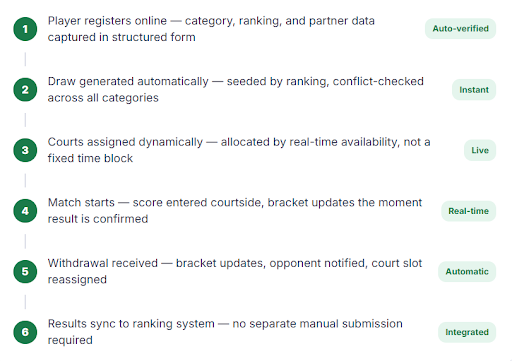
Smart tournament scheduling software doesn’t just make existing processes faster — it replaces the manual logic that creates conflicts in the first place. Here is what changes at each problem point:
How Smart Scheduling Automation Works — Step by Step
What This Means for the Organiser on the Ground
The most important shift automated tournament management creates isn’t visible in any single feature. It’s the cumulative effect of removing six or seven tasks that used to demand the organiser’s attention simultaneously. When the bracket updates itself, when courts are reassigned automatically, when players receive notifications without anyone drafting and sending them — the organiser gets their day back.
That time doesn’t disappear. It goes toward the parts of a tournament that still require a human: reading the room when a dispute needs diplomacy, noticing that two courts are running behind and making a judgment call, making the closing ceremony feel genuinely celebratory rather than rushed. Sports tournament scheduling software doesn’t replace the organiser. It gives them back the capacity to actually organise.
Tenniskhelo
India’s Tennis Tournament Management Platform · khelo Toh Sirf TennisKhelo
Smart Scheduling, Live Draws & Court Booking — In One App
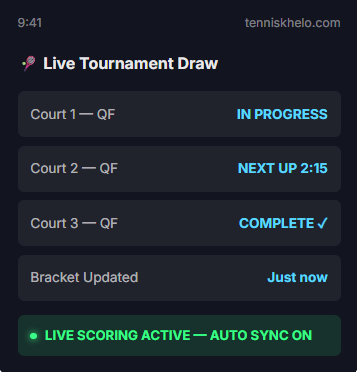
Tenniskhelo is India’s leading tennis tournament management platform, and its court booking software and live score tournament management system are built around exactly the automation framework described in this article. Organisers running events on Tenniskhelo experience automated draw generation, instant withdrawal management, real-time score sync, and direct AITA ranking integration — all from a single mobile-first platform built for the Indian racquet sports context.
- Automated draw generation with seeding
- Live scoring synced to bracket
- Online court booking
- AITA & ITF ranking integration
- Player notifications — automatic
Worth Noting
The sports event management software market will reach $1.92 billion in 2026 and is expected to grow to $3.41 billion by 2034, with a 7.8% CAGR. Sports organizations, clubs, and tournament organizers continue to drive this growth by adopting automated solutions that improve efficiency, simplify tournament scheduling, and streamline event management.
The Organiser Who Doesn’t Panic Is Using the Right Software
The best tournament days look effortless from the outside. Players arrive knowing where to be. Courts are always ready. The bracket always reflects reality. Nobody is standing in the middle of the venue with a clipboard, recalculating. That experience — for players, spectators, and organisers alike — is what tournament scheduling software in India and globally is being built to deliver consistently, not just on lucky days.
The technology exists. The organisers using it are already running better events. The gap between them and everyone else is just a decision.
Frequently Asked Questions
What is tournament scheduling automation?
Tournament scheduling automation refers to software that handles court assignment, match sequencing, draw updates, and player notifications automatically — without manual input from the organiser for each step.
How does smart automation reduce scheduling conflicts in tournaments?
Smart automation reduces scheduling conflicts by checking player availability across multiple categories before match day, assigning courts based on real-time availability, and instantly updating the bracket whenever officials enter match results or players withdraw.
What features should tournament scheduling software have?
Good tournament scheduling software should include automated draw generation, real-time court allocation, live score tracking, instant withdrawal management, automated player notifications, and integration with national ranking systems.
Is tournament automation software suitable for small clubs?
Yes. Automated tournament scheduling software is useful for events of all sizes. Even a 16-player club event benefits from automated draws and live scoring, since manual errors are just as disruptive at a smaller scale.