I once watched a tournament director redraw an entire 32-player bracket by hand after a last-minute withdrawal. It took him almost forty minutes, three eraser marks that tore through the paper, and a level of quiet frustration I could feel from across the room. By the time he finished, two players had already come over to ask why the schedule hadn’t been posted yet.
That memory sticks with me because it’s such a small moment, but it captures exactly why automated tournament draws software has become such a big deal in sports events over the last few years. Drawing brackets by hand isn’t just slow. It’s fragile. One change and the whole thing has to be rebuilt from scratch.
What a Manual Draw Actually Looks Like Behind the Scenes
Most sports players never see this part, but a manual draw is a lot more chaotic than it looks once it’s printed and taped to a wall. Someone’s manually assigning seeds based on rankings, double-checking there are no repeat matchups from qualifying rounds, and physically drawing lines to connect names — all while trying not to make a mistake that six people will point out an hour later.
Here’s roughly what that process tends to look like next to its digital counterpart:
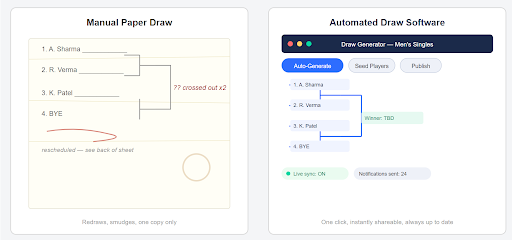
Notice the difference isn’t just aesthetic. The paper version has corrections, smudges, and exactly one copy that exists in the world. The digital version updates instantly and can be shared with every player at once, the moment it’s generated.
How Automated Draws Actually Work
Automated tournament draws aren’t magic — they’re just rules applied consistently and instantly instead of manually, match by match. The software takes registered players, applies seeding based on ranking or skill level, avoids early-round repeat matchups where required, and builds the entire bracket in seconds rather than hours.
What used to be a director hunched over a printed sheet with a pencil becomes a single click. And because the whole thing lives in software rather than on paper, adjustments — a withdrawal, a bye, a late addition — get absorbed into the bracket instantly instead of requiring a full redraw.
This is what that process looks like once it’s actually running during an event:
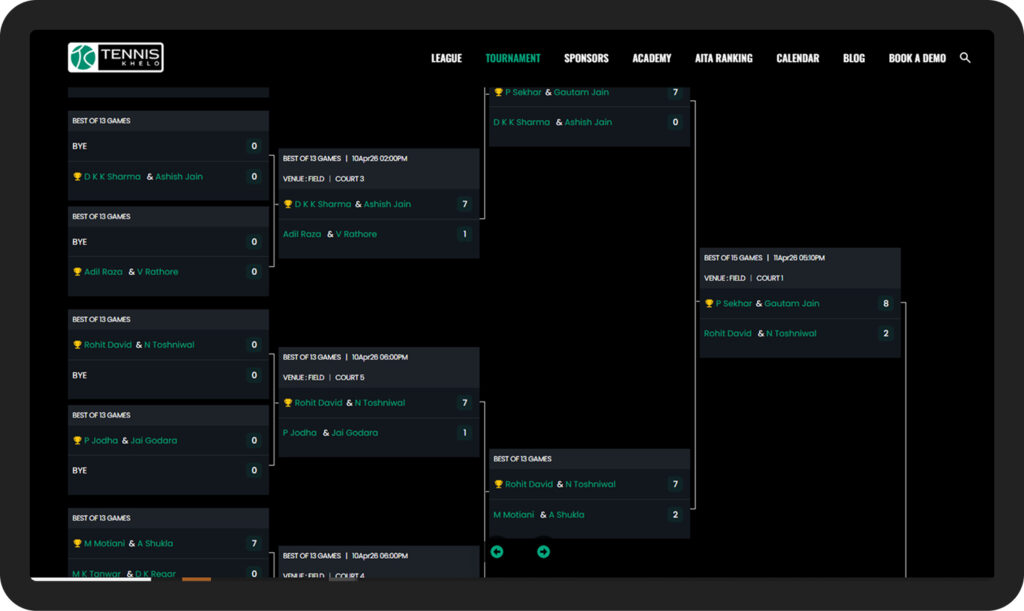
That activity feed on the right is the part that matters most, honestly. Every action — a score entered, a court reassigned, a rain delay applied — ripples through the bracket automatically and notifies affected players without anyone having to manually track who needs to know what.
Why This Actually Matters for Event Day
It’s easy to treat draw automation as a nice convenience and move on, but the real impact shows up in moments that used to derail entire tournaments.
Take a withdrawal an hour before matches start. Manually, that means finding the affected part of the bracket, redrawing it, reprinting it, and physically informing every player whose match time shifted. With auto tournament draws, the bracket recalculates on its own, and the affected players get a notification before they’ve even noticed something changed.
Or take a common scoring dispute — two people disagreeing about who actually won a match three rounds back. A manual bracket relies on someone’s memory or a scribbled note. A digital draw has a timestamped, unchangeable record of every result, which usually ends the argument in under a minute.
There’s also a fairness angle that doesn’t get talked about enough. Manual seeding, done under time pressure, is more prone to human bias or simple oversight — accidentally pairing two top seeds too early, for example. Automated bracket generation applies seeding rules consistently every time, without the fatigue factor that creeps in during a long, stressful event day.
The Ripple Effect on Scheduling and Courts
Draws don’t exist in isolation. Once a bracket is set, it drives court assignments, match timing, and staffing. When the draw itself is unstable — constantly being redrawn or corrected — everything downstream becomes unstable too.
Automated systems solve this by treating the draw as a living structure rather than a fixed printout. When a match result comes in, the next round populates on its own, court assignments adjust, and the schedule reflects reality instead of a plan made two days earlier that’s already out of date.
Built for the Sport, Not Just Adapted to It
Generic bracket generators exist, but sports with specific formats — doubles pairings, skill-based seeding, multiple simultaneous categories — need something built with that structure in mind from the start.
Tenniskhelo is a strong example of this, offering automated tournament draws software designed specifically around how tennis tournament are structured, including doubles seeding and category-specific rules, rather than forcing organizers to adapt a one-size-fits-all bracket tool to fit a sport it wasn’t built for.
The Bottom Line
Draw automation isn’t really about replacing the tournament director’s judgment — seeding decisions, wildcard entries, and format choices still belong to a human. What it removes is the slow, error-prone manual labor that used to sit between those decisions and an actual playable bracket. Given how much of an event’s smoothness depends on getting the draw right the first time, it’s easy to see why so many organizers aren’t going back to pencil and paper.